Do I need a recognition of paternity?
Recognition of paternity is needed if
- you received German citizenship at birth or qualify for naturalization due to sex discrimination after 1949
- and you or one of your ancestors was born out of wedlock
- and the line of German descent runs through the father
The recognition of paternity had to fulfill specific requirements. These requirements changed over time. We start with a list of the most common cases where the requirement for paternity recognition was clearly met - or not met.
Paternity was sufficiently recognised if ...
-
... the child was born since 1 September 1986, the father recognised the child before the child’s 23rd birthday under the law of the country where the child lived, and that made him the legal father under local law. Examples:
-
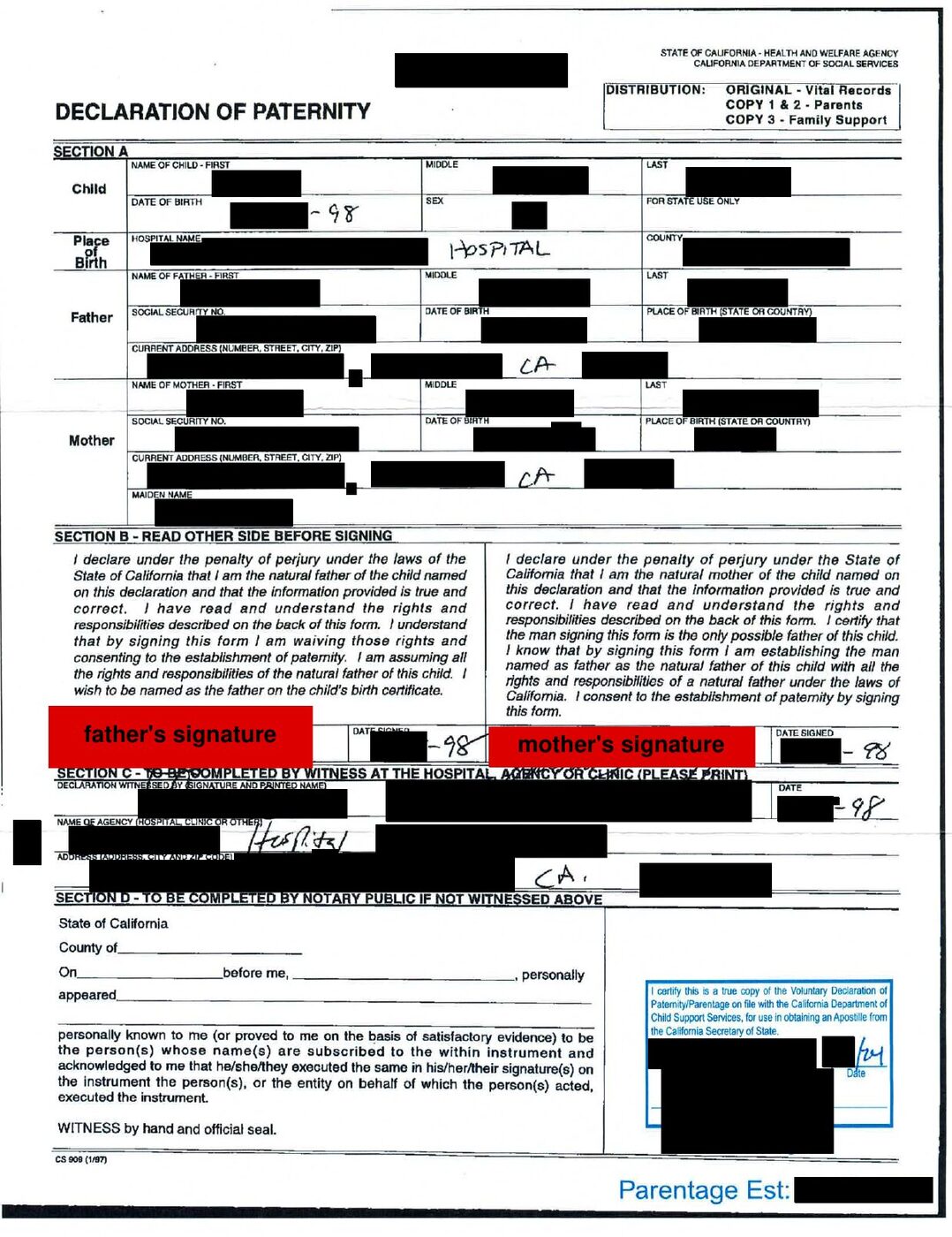
An acknowledgment of paternity signed by both parents in a US state
Example: a California Declaration of Paternity signed by both parents and witnessed at the hospital in 1998 (personal data redacted).
-
The father having himself entered as the father when the birth was registered in Brazil
-
-
... the father declared that he is the father, the mother declared that she consents to his declaration, and both declarations were recorded since 1 July 1998, while the child was under 18 years old, either by an authority that local law allows to record paternity declarations, or by a German consulate. In Germany these authorities are the youth office (Jugendamt), the civil registry office (Standesamt), notaries and the courts.
-
... a court decided that he is the father, in a case started before the child's 23rd birthday. This can be a German court or a foreign court. Germany recognises a foreign paternity judgment without any special procedure unless a statutory ground for refusal applies. A decision that only orders child support is not covered by this item unless this decision also made him the legal father under local law.
-
… the child's birth is entered in the birth register of a German civil registry office (Standesamt) with him as the father, based on a recognition of paternity made before the child’s 23rd birthday.
Note: Recognitions recorded since 29 July 2026, including recognitions under foreign law, can also need the consent of the German immigration authority or the German mission.
Paternity was not sufficiently recognised if ...
... neither a recognition of paternity nor a court case on paternity was declared before the child's 23rd birthday.
… the child was born before 1 September 1986, the father held only German citizenship, and the father recognised the child between 1 July 1970 and 31 August 1986 while the child lived outside of Germany. These recognitions fail since German law at this time required the consent of the child, whose interests had to be represented by the youth office or court-appointed guardian (not the mother), which children born abroad almost never had.
... the mother was married to another man when the child was born, and his paternity has not been removed by a successful court challenge. If any law that applied at the birth makes the husband the legal father (as is the case in most countries), the German father cannot recognise the child while the husband's paternity stands.
... the father is named as father in the foreign birth record in a country where this alone does not make him the legal father. A name in a register counts as recognition only where the law of that country treats it as one.
… you can prove with a DNA test that a German citizen is the biological father, but no court process to recognize him as the legal father was started before the 23rd birthday of the child.
If your case is on neither list
Here is a legal memo that explains the legal situation: https://www.germanlegacy.net/law/paternity/
Be warned that it will get fairly complicated.